
Decolonization comes with its share of resistance. It’s not easy to give up control. Because wrapped deep within our human capacities to control and colonize rests our desire that feeds our deepest motivations. For the colonizer, the foolish confidence from having won a victory is motivation to go next for the kill, to wrest as much as one can from the colonized. For the colonized, foolish confidence is in the form of the disguised dependence upon the colonizer as the benefactor for even the basic things of life that constitute our identity as persons, a people, and even as a nation.
For example, when the British “Quit India,” it wasn’t after a struggle to wrest as much as they could from the massacred population, leaving millions on the brink of starvation.
I hate Indians. They are a beastly people with a beastly religion. The famine was their own fault for breeding like rabbits. –Winston Churchill
quoted in Choudhury,; 2021, p. 1; Portillo, 2007; Tharoor, 2010), https://www.ncbi.nlm.nih.gov/pmc/articles/PMC9735018/
In a report on Bengal under British rule, we see that before the Battle of Plassey, the people of Bengal were economically prosperous, having a better standard of living than most Europeans at the time. However, the tax imposed by the British, ranging from 10% to 50% of the agricultural produce, devastated the economy. The British East India Company (the central arm of British colonization in India) severely damaged the capacity of the indigenous population to produce. Further, the road to survival, let alone economic prosperity, could happen only through unqualified dependence upon the gracious kindness of the benefactor, in this case, the British, who derived their wealth from colonial enterprise thanks to the efforts of the British East India Co.
Colonizing is akin to crushing the bones but leaving the flesh intact. The impact of colonization puts the body on life-support systems, creating a further dependence on oxygen supplied through the gracious hands of the colonizer. The so-called backbone of the Indian economy, the agricultural sector, was destroyed by cash crop demand, such as cotton and indigo over rice cultivation. Further, the East India Co. cared more about revenue collection than investing in a sustainable irrigation system.
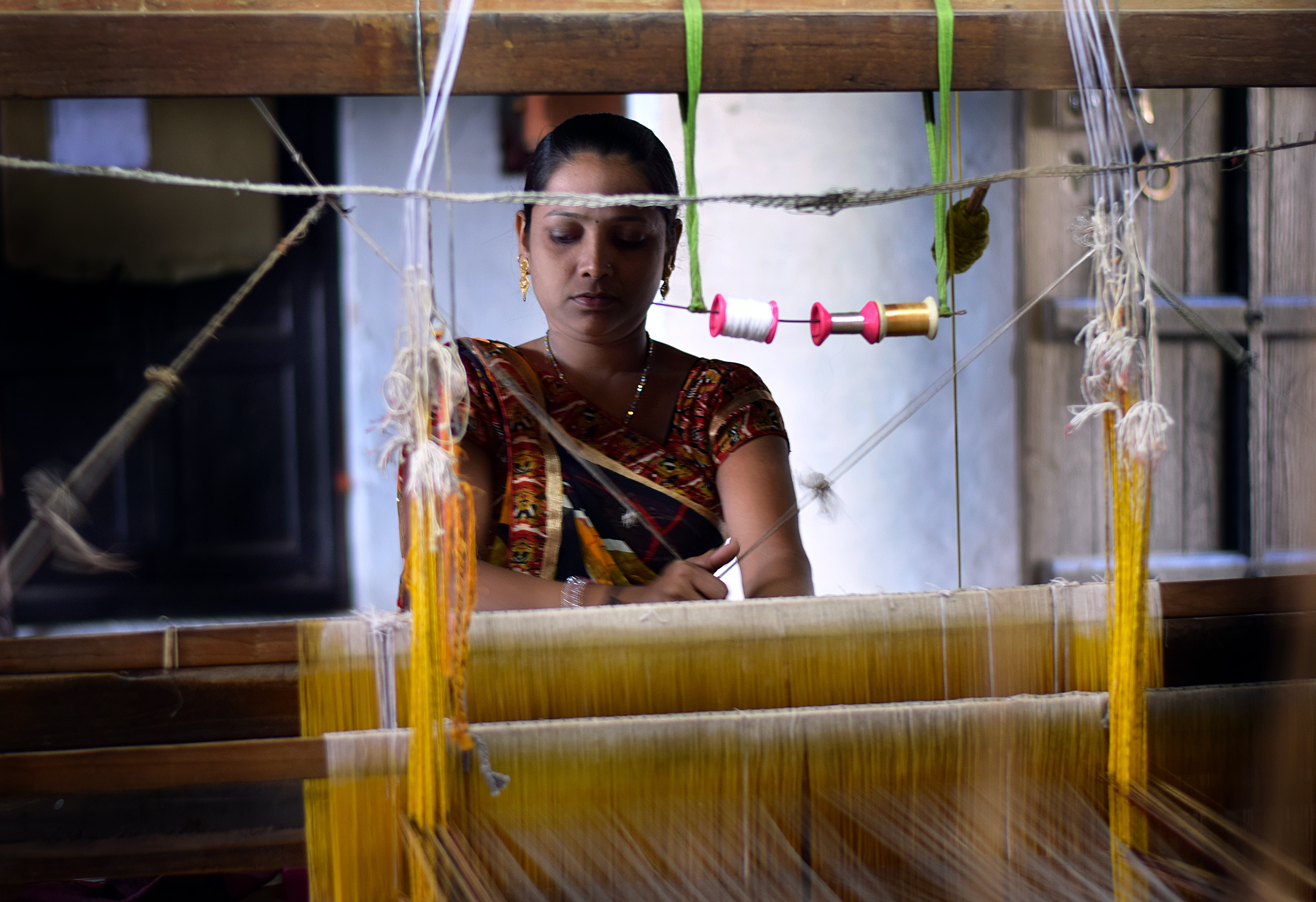
Consider the extent of the commercialization of creativity. The handloom products that we now celebrate in our cottage industries have a backstory. The Company forced weavers to weave cotton until they broke their backs for a wage that hardly afforded them a full meal at the end of the day. These artisans were starving. One historical review recollects how these weavers resorted to cutting their thumbs to avoid forced labor, others sold their children, and others escaped to different countries to avert the means of the colonizer’s creative enterprise.
The EIC (East India Company or Company, hereafter) further enforced that peasants would produce only raw materials, not finished products of cotton or silk. Further, to retain complete control over the process, the artisans could develop raw materials only on “company-owned properties and not at the farmer’s cottage” (ibid., 45). The reassignment of product value moved further up the manufacturing process, naturally diminishing the value potential of the raw material manufacturing part of the product chain. The raw material is now at the consumer’s disposal and demand, in this case, the Company. The actual design and production of the final product rested in the hands of designers who could manufacture as per the standards and tastes of the European market–not too far from what we have in the form of “world music” from the occident created from digital samples of tribal artists to cater to the tastes of global audiences, whose demands are met in large part by enterprise revenues located in the Global North.
The principal aim of biopolitics is to turn individuals into governable objects, and colonial famines in India provide a perfect context to examine the role of biopolitics in consolidating and expanding bio-inequality in the Global South and how indifferences of those at the top of the power structures disregard the bodies of the poor people forcing them to die.
Mallik, Senjuti. “Colonial Biopolitics and the Great Bengal Famine of 1943.” GeoJournal vol. 88,3 (2023): 3205-3221. doi:10.1007/s10708-022-10803-4
The famine of 1770 (not the one in 1943 that Churchill commented on in the quote above) resulted from the one-way flow of money from India to Britain. A third of the population, approximately 10 million, starved to death. It was the year that the Company had the highest revenue collection from the land. Apparently, and not entirely irrelevant, is the fact that in the period of British rule in India (1858-1947) there were 25 major famines, in which 25 million Indians are estimated to have died compared to 5 million deaths throughout the world due to wars from 1793 to 1900 (Mallik 2023, 3208).
Economic prosperity is linked to creative freedom. Likewise, the creative freedom afforded to humanity (all persons, equally) is how we can prosper as a human community.
The economic prosperity from a “heaven on earth” scenario is not to be separated from the artist’s creativity. The challenge for us as creatives is to be confronted with our capacity to control continually—the textures or substances that we work with, how we choose to add value—and yet respond to the reality of our creativity afforded to each of us by the Creator of All.
Further, are we creating an unhealthy dependence by people on our products by what we make? Additionally, does how we create empower and uplift others to regain the confidence to create for themselves a better future?
Collaboration in this day and age is to be celebrated as long as there is a fair exchange and equitable outcomes for all participants. We can’t expect current generation persons to be held entirely responsible for historical aberrations committed by their ancestors. At the same time, we cannot be oblivious to our economic histories that have given rise to and continue to sustain the economics of our corporations, churches, and creatives-at-large.
Photo by Nishant Jadhav on Unsplash. thank you!

