
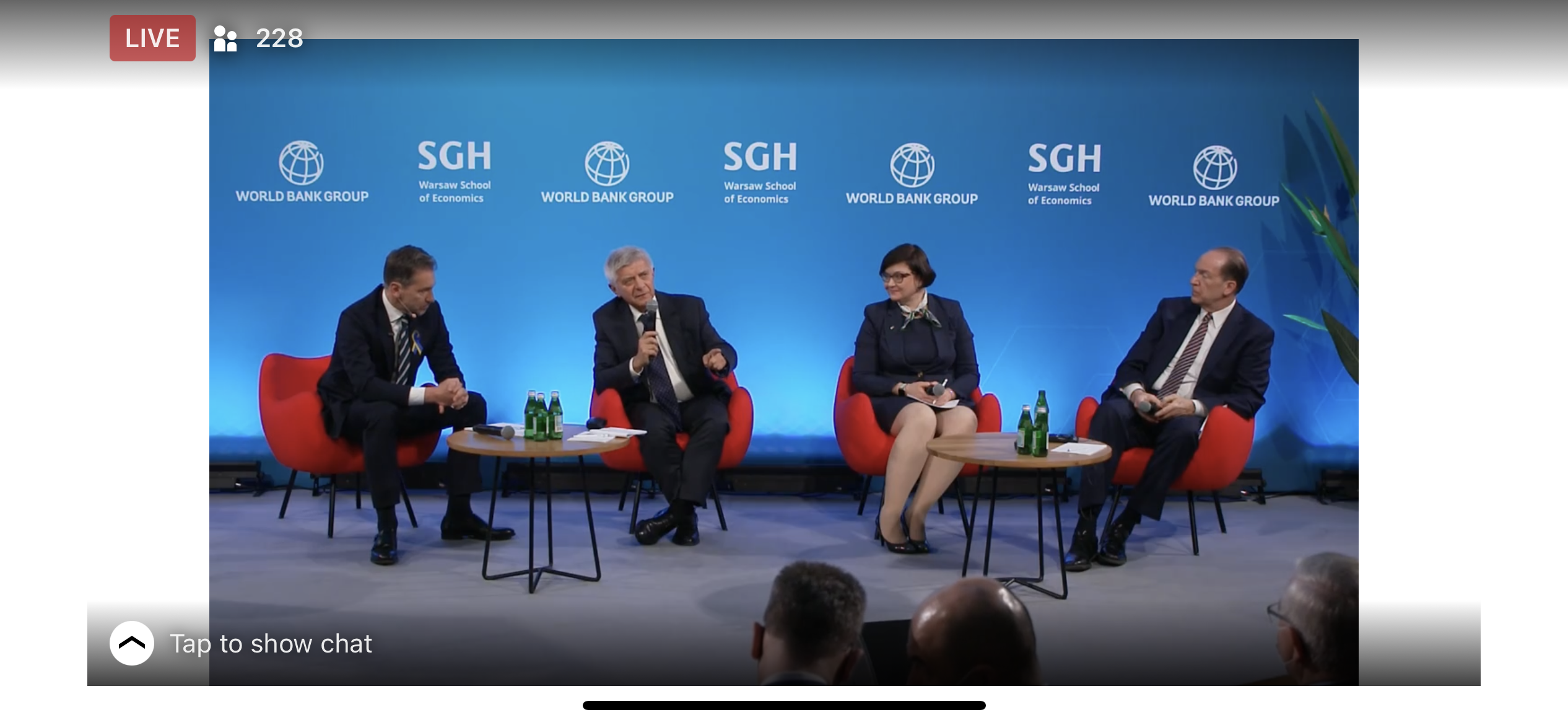
Apr 12, 2022, 7:30 AM – 8:30 AM EDT (screen shot of event)
According to a Polish Member of Parliament, in the recent World Bank and Warsaw School of Economics live broadcast event, we need to teach in schools how to work together, what it really means to be a civil society, the place and role of the local government with the caveat that the State is never first but nevertheless it is necessary, an enabler of human potential.
We need to value working together—people, social organizations, local and central governments…all necessary in a time of crisis.
The Polish MP recollected a conversation with another political dignitary—”peace is more important than air-conditioning,” and further qualified the statement, “obvious, but not for all.”
What is your solution for how we can better collaborate to solve the issues facing humanity? What values must first be in place if we are to come up with the right kind of solutions? How can we begin to communicate such values through our art and policies, in our homes and workplaces? What's obvious and what's not?
While we can work toward a common unity, commonly unite around peace and justice and equity and other lofty ideals, it’s not really the same as community.
As long as the common axis for each nation, corporation, religion, and economy is centered upon the self—"what's in it for me and mine alone?"—it will become increasingly harder for us to experience the sort of community that we truly desire and need as a collective human economy.
This latter, our common human diversity as a redemptive place for the generation of new knowledge economies, can only be possible when we are centered upon a Common Other that causes us to be willing to preference the needs of others before our own. Interdependence and mutuality for personal gain as a primary driving force is very different from interdependence and mutuality from putting the needs of others first, it calls for a very different kind of oikonomia or ecosystem.

